
JICUF VP Presents at the Asia-Pacific Association of International Education (APAIE) Conference in Hong Kong
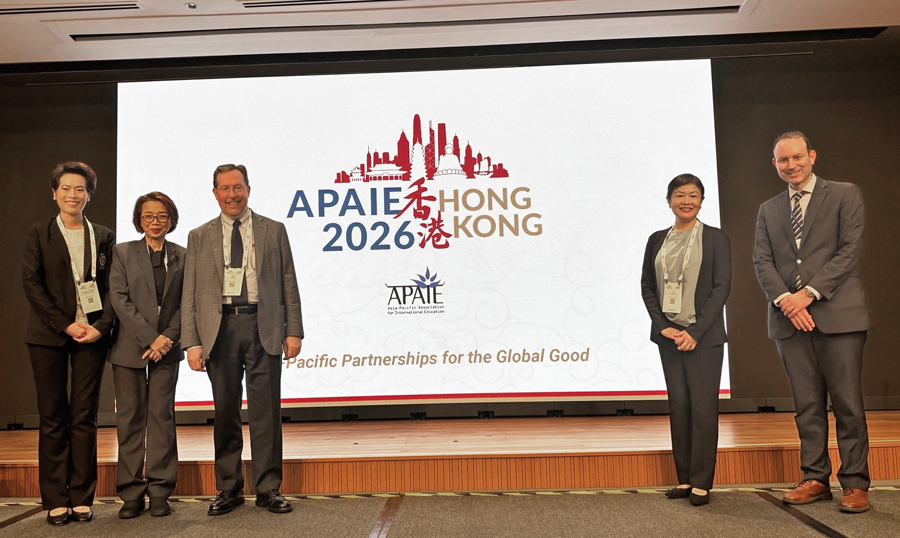
On February 25, JICUF Vice President Aki Takada attended the Asia Pacific Association of International Education (APAIE) conference in Hong Kong and spoke on a panel on “Partnerships for the Global Good: Expanding Opportunity for At-Risk Students and Scholars.” Moderated by Jason Czyz, President of the Institute for International Education (IIE), Aki joined Luksmon Smansin of the Thai Ministry of Higher Education, Nopraenue Sajjarax Dhirathiti of Mahidol University and Jonah Kokodyniak of IIE to introduce how each organization was working to expand educational opportunities for displaced or at-risk students.
Mr. Czyz opened the session by framing global trends and strategic partnership approaches, drawing on insights from IIE’s work supporting refugee and at-risk populations. Aki presented on JICUF’s work in the last decade to establish and expand “education pathways,” programs that admit and provide protection to displaced youth through higher education opportunities in Japan. Dr. Smansin provided insight into regional mobility policy and the Thai government’s role in expanding pipelines for displaced learners, and Dr. Dhirathiti explained in depth Mahidol University’s system for supporting these students. Finally, Mr. Kokodyniak gave an overview of both permanent programs and custom initiatives which have helped thousands of students access higher education from 20 origin countries.
In the discussion that followed, Mr. Czyz asked Aki to touch on how Japanese universities have applied flexibility in admissions, and what lessons might apply to other countries. Aki mentioned that universities in Japan have shown some flexibility. For example, at least one university (ICU) has adopted the one-step application process, where applicants do not have to apply separately to the university and the scholarship program, and all host institutions have accepted copies of important documentation instead of originals. She explained that two major issues that remain to be addressed are high school equivalency and standardized test scores. For refugee students who study in unaccredited high schools, the door to higher education is virtually closed because their graduation certificates are not recognized as proof of completion of secondary education. Furthermore, even if students graduate from accredited high schools, universities typically require scores of standardized tests such as the SAT and ACT, which are often unattainable for refugees. It is vital that higher education institutions consider alternative qualifications such as the UNESCO qualifications passport and Amala Education’s Global Secondary Diploma.
A lively Q&A session rounded out the panel. The annual APAIE Conference and Exhibition is one of the largest higher education networking events in the Asia-Pacific. This year’s event brought close to 3,000 participants both from within and outside the region.


