
JICUF Grantee Highlight: Singing Songs and SDGs Storytelling in Spanish Class
Project title: “Singing Songs and SDGs Storytelling in Spanish Class”
Grant recipient: Adiene Hishiyama, Instructor of Spanish
Amount awarded: 300,000 yen
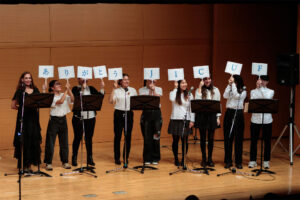 Adiene is on the far left (All photos on this page taken by Yu Goto)
Adiene Hishiyama, who has been teaching Spanish at ICU since 2018, held a workshop on learning Spanish songs with support from JICUF’s faculty grant. This workshop not only improved the participants’ vocabulary and pronunciation through singing, but also explored issues such as migration and poverty which were reflected in the songs.
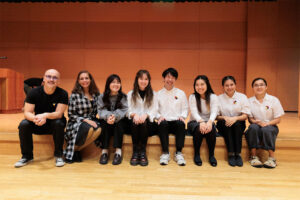
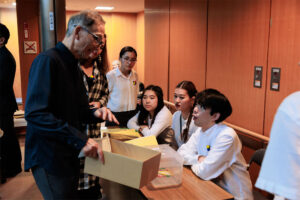
The project culminated in a performance at the Nishi-Tokyo City Cultural Festival held in November 2024. Through this project, the students not only improved their Spanish skills but also gained a deeper understanding of the culture, a broader worldview, and a renewed sense of responsibility to build a better, sustainable future.
Adiene contributed the following report on the project.

Voices for a Sustainable Future: How Spanish Songs and Storytelling Inspired Global Citizenship at ICU
In an ever-globalizing world, education must go beyond the classroom to nurture compassion, awareness, and action. That’s precisely what the SDGs, Spanish Songs, and Storytelling Project achieved. Supported by the Japan International Christian University Foundation (JICUF), this innovative initiative brought together language, music, and multicultural dialogue to promote the United Nations Sustainable Development Goals (SDGs) and inspire students to embrace their roles as global citizens.
Bridging Cultures Through Music and Meaning
At its core, the project aimed to empower students by using music and storytelling as tools to explore the 17 SDGs, fostering an educational experience that emphasizes diversity, inclusion, and sustainability—values deeply aligned with both JICUF’s mission and UNESCO’s educational vision. Through a series of dynamic workshops, participants studied the lyrics of iconic Spanish songs such as Guantanamera, Motivos, el manicero, Venezuela, Volver, Lágrimas negras and Chiquitita, practiced singing them, and engaged in meaningful discussions about how the music connects to pressing global challenges. The culmination of the project was a powerful presentation at the Nishitokyo City Cultural Festival 2024, and we did an in campus presentation in collaboration with SSS group at ICU (Latin fest event), where students shared their learnings through performances that celebrated Latin American culture and its contributions to peace and sustainability.
Learning Spanish, Living the SDGs
For many participants, this was more than a language class. It was a transformative journey of discovery. “It definitely helped my pronunciation,” shared one student. “Besides, singing makes learning new vocabulary so much fun.” Another added, “I think the workshop definitely helps people improve or learn Spanish. By learning the lyrics and the meaning and story behind them, it becomes a fun and immersive way to learn a language.” Language learning became a bridge to empathy, as students delved into stories of migration, poverty, and resilience embedded in the songs. One participant reflected, “Guantanamera workshop connects me with the spirits and quality of Caribbean and Latin people. As a Latin migrant living in Japan, it is sometimes difficult to overcome the lack of communication and social contact. Listening to this song connects me to my roots.” Such reflections embody JICUF’s institutional goal of nurturing students who contribute to the well-being of humanity by engaging deeply with cultural diversity.
Music as a Catalyst for Social Awareness
What makes this project stand out is its profound emotional and intellectual impact on students. Discussions went far beyond grammar and vocabulary; they ignited dialogue about inequality, climate change, and cultural identity.
“We analyzed the songs Volver, Motivos, Lágrimas negras. It’s a great example of unity among people facing hardship,” said one participant. “It spreads hope and courage.” Another student observed: “Through the lyrics, I was able to focus on the problem of poverty. The singer sings about having nothing but the sea and earth. It made me reflect on how poverty can be pervasive and invisible.” By making connections between personal stories and global goals, the project exemplified how education can be a tool not only for knowledge but for transformation.
Cultivating Peace, Tolerance, and Cultural Awareness
The project did not stop at language acquisition or musical appreciation—it built a culture of peace and a space for intergenerational and intercultural dialogue. “This was a great opportunity to reflect on one’s experience of ‘home’ and understand that people, regardless of where they come from, have values worth appreciating.” “It opens our perspective of the world and highlights how similar we are as humanity,” noted another. This inclusive spirit echoed through the Latin Festival, where participants and guests from all over the world joined in the celebration. “The Latin Fest event was a total success,” said a student. “It was evident that the music connected everyone in the room in the most beautiful way. Even some attendees joined in singing the choruses.” By breaking stereotypes, students reported gaining a more nuanced view of Latin America. As one remarked, “Knowing different cultures is the first step to promote a spirit of tolerance.”
A Living Example of the SDGs in Action
The project highlighted how creative expression and multilingual learning can advance the SDGs in practical, human-centered ways. Students engaged with key goals such as:
Goal 4: Quality Education, by fostering inclusive, equitable learning through storytelling
Goal 10: Reduced Inequalities, by highlighting the challenges of underrepresented communities.
Goal 16: Peace, Justice, and Strong Institutions, by encouraging reflection on non-violence and community-building.
A Shared Vision for the Future
In line with JICUF’s commitment to sustainability, peacebuilding, and intercultural exchange, this project modeled how academic programs can cultivate not only intellect but also heart. “This workshop was absolutely enriching and revealing. It gave me new creative insights into how music and culture bridge language barriers and diverse identities.” “Being able to talk and explain the meaning of these songs to people unfamiliar with the culture is a great way to introduce a culture of peace,” emphasized another. Students walked away with more than improved Spanish skills—they gained a deeper appreciation of culture, a broader worldview, and a renewed sense of responsibility toward building a better, more sustainable future.
Final Thoughts
In an era when the world often feels divided, projects like this remind us of the unifying power of music and the role of education in shaping compassionate global citizens. Thanks to the support of JICUF, the Spanish Songs and Storytelling Project created lasting connections, empowered student voices, and planted seeds of change—one song at a time.
Special thanks to all the ICU students who participated in this project for their outstanding work. A heartfelt and profound acknowledgment goes to Dr. Daniel Quintero, coordinator of the Spanish courses at International Christian University. His efforts not only made the realization of this innovative project at ICU possible but also proved indispensable in coordinating the musicians during both the event and the rehearsals at the university.
Adiene Roque de Hishiyama


